Ledger Wallet Security: Stax, Flex & Trezor Comparison
Understanding ledger wallet security architecture helps evaluate premium devices like ledger wallet stax and ledger wallet flex against competitors.
Ledger Wallet Security Architecture
Secure Element Technology
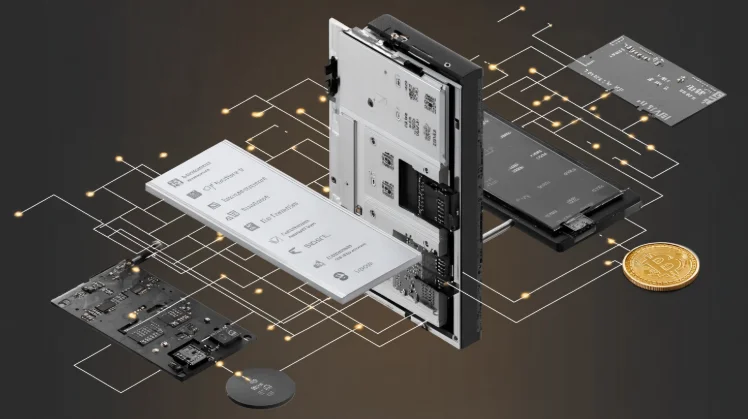
Ledger wallet security centers on certified secure element chips—specialized processors designed specifically to protect cryptographic secrets. These ST33 series chips differ fundamentally from general-purpose processors in computers or phones.
Secure element protection includes physical tamper resistance with detection mechanisms that destroy data if attackers attempt to access the silicon directly. Side-channel attack protection prevents extraction of secrets through power consumption analysis, electromagnetic emissions, or timing variations. Fault injection countermeasures defeat attempts to manipulate chip behavior through voltage or clock manipulation. Certified random number generation ensures unpredictable key creation meeting cryptographic standards.
Ledger devices carry CC EAL5+ or EAL6+ certification from independent testing laboratories, plus ANSSI certification from France's National Cybersecurity Agency. This dual certification provides robust assurance of security claims. Learn how to secure your Bitcoin with Ledger hardware wallets in our comprehensive guide.
How Keys Are Protected
The ledger wallet security model ensures private keys never exist outside the secure element. During initialization, keys generate inside the chip using certified random number generators. Keys lock immediately within protected memory. Transaction signing occurs entirely on-chip—only signatures exit, never actual keys.
When you send cryptocurrency, your computer prepares an unsigned transaction. This data transmits to the Ledger device. The secure element receives the transaction, displays details on the device screen, and waits for physical button confirmation. After approval, the chip signs using keys that remain inside. Only the signed transaction returns to your computer.
This architecture means malware on your computer cannot access private keys or authorize transactions without physical device interaction and PIN entry. For complete security setup, see our setup and troubleshooting guide. Learn about latest features and updates that enhance your wallet security.
Ledger Wallet Stax: Premium Review
The ledger wallet stax ($399) represents Ledger's premium flagship, designed for users who value aesthetics alongside security. After purchasing your device, follow our download and installation guide and setup tutorial to get started.
Design and Display
The Stax features a stunning 3.7" curved E Ink touchscreen—the same technology used in e-readers. This display enables customizable lock screen artwork (display your favorite NFT when idle), excellent readability in any lighting condition, minimal power consumption extending battery life, and premium visual impression unlike any other hardware wallet.
Physical construction uses premium materials at 85mm x 54mm x 6mm dimensions weighing 45 grams. The design intentionally resembles a credit card for discretion. Magnetic backing enables stacking multiple Stax devices.
NFC capability allows tap interactions for compatible applications—a unique feature in hardware wallets.
Features and Experience
The ledger wallet stax includes CC EAL6+ secure element matching Nano S Plus certification, Bluetooth 5.2 for wireless connectivity, Qi wireless charging eliminating cable clutter, 200mAh battery providing 10+ hours active use, full iOS and Android support via Bluetooth, and 100+ simultaneous cryptocurrency apps.
The touchscreen interface eliminates two-button navigation—all interactions occur through intuitive taps and swipes. Transaction verification displays full details clearly on the large screen.
Who Should Buy Stax
The ledger wallet stax suits premium users where cost is secondary to experience, collectors who want to display NFT artwork on their wallet, design-conscious individuals valuing aesthetics, high-net-worth portfolios where $399 is negligible relative to holdings, and gift buyers seeking impressive hardware wallet presentation.
Stax may not suit budget-conscious users (equivalent security available for $79), users satisfied with Nano form factor, and those who don't value touchscreen or display features.
Ledger Wallet Flex: Mid-Tier Review
The ledger wallet flex ($249) bridges the gap between Nano devices and premium Stax. Once you have your device, install Ledger Live and follow our complete setup guide to configure it properly.
Design and Display
The Flex features a 2.8" color touchscreen—smaller than Stax but larger than any Nano. This display enables touchscreen navigation eliminating button interfaces, clear transaction detail verification, and color display for visual richness.
Physical construction at 78mm x 43mm x 8mm weighing 57g is larger than Nano devices but smaller than Stax. The rounded rectangular design is modern and professional.
Features and Experience
The ledger wallet flex includes CC EAL6+ secure element (highest certification), Bluetooth 5.2 for wireless connectivity, Qi wireless charging, 200mAh battery providing 10+ hours active use, full iOS and Android support, and 100+ simultaneous cryptocurrency apps.
The touchscreen experience is smooth and responsive. Interface design follows modern smartphone conventions—intuitive for users familiar with touchscreen devices.
Who Should Buy Flex
The ledger wallet flex suits users wanting touchscreen without flagship pricing, those upgrading from Nano who want modern interface, mobile-focused users needing Bluetooth, and users valuing wireless charging convenience.
Flex may not suit extreme budget focus (Nano S Plus at $79 provides equivalent security), users satisfied with Nano button navigation, and those wanting premium status (Stax offers more distinctive design).
Ledger Wallet vs Trezor: Security Comparison
Secure Element vs Open Source
The ledger wallet vs trezor security debate centers on different philosophical approaches.
Ledger uses certified secure elements with partially closed-source firmware. The secure element provides hardware-level key isolation validated by independent laboratories. Critics note the secure element firmware cannot be independently audited.
Trezor traditionally used general-purpose processors with fully open-source firmware. The open-source approach allows complete code auditing but lacks hardware-level key isolation. Notably, Trezor Safe 3 and Safe 5 (2023+) now include CC EAL6+ secure elements, partially converging with Ledger's approach.
Current security status for the ledger wallet vs trezor comparison shows Ledger Stax with CC EAL6+ secure element, Ledger Flex with CC EAL6+ secure element, Ledger Nano S Plus with CC EAL6+ secure element, Ledger Nano X with CC EAL5+ secure element, Trezor Safe 3 with CC EAL6+ secure element, Trezor Safe 5 with CC EAL6+ secure element, Trezor Model T with no secure element, and Trezor Model One with no secure element.
Feature Comparison
Beyond security, the ledger wallet vs trezor comparison reveals feature differences.
Ledger advantages include Bluetooth connectivity (Trezor has none), iOS support (Trezor cannot connect to iPhone), larger touchscreen options (Stax, Flex), and ANSSI government certification.
Trezor advantages include fully open-source firmware, Shamir Backup for split recovery phrases, touchscreen on Model T at lower price, and on-device passphrase entry.
Complete Comparison Table
| Feature | Ledger Stax | Ledger Flex | Trezor Safe 5 | Trezor Model T |
|---|---|---|---|---|
| Price | $399 | $249 | $169 | $179 |
| Secure Element | CC EAL6+ | CC EAL6+ | CC EAL6+ | None |
| Screen | 3.7" E Ink touch | 2.8" color touch | 1.54" color touch | 1.54" color touch |
| Bluetooth | Yes | Yes | No | No |
| Battery | 200mAh (10+ hrs) | 200mAh (10+ hrs) | No | No |
| Wireless Charging | Qi | Qi | No | No |
| NFC | Yes | No | No | No |
| iOS Support | Yes | Yes | No | No |
| Open Source | Partial | Partial | Full | Full |
| Shamir Backup | No | No | Yes | Yes |
| Design | Premium curved | Modern rounded | Compact | Compact |
| Best For | Premium, collectors | Touchscreen seekers | Open-source + SE | Open-source fans |
Which Device Should You Choose?
Based on this ledger wallet security analysis:
- Choose Ledger Stax if you want premium design and distinctive aesthetics, you value E Ink display and NFC features, cost is not a primary constraint, and you want to display NFTs on your device.
- Choose Ledger Flex if you want touchscreen without premium pricing, you need Bluetooth and iOS support, you prefer modern interface over Nano buttons, and wireless charging appeals to you.
- Choose Trezor Safe 5 if you prioritize fully open-source firmware, you want secure element at lower price than Flex, you don't need Bluetooth or iOS support, and Shamir Backup appeals for recovery security.
For pure security focus: All devices with CC EAL6+ secure elements (Stax, Flex, Nano S Plus, Safe 3, Safe 5) provide equivalent cryptographic protection. Price differences reflect features and design rather than security levels.